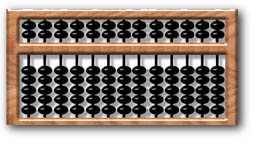
THE ABACUS
The abacus is a calculator whose earliest known use is circa 500 B.C. by the Chinese civilization. Addition, subtraction, division and multiplication can be performed on a standard abacus. Beginning in about 1600 A.D., use and evolution of the abacus was begun by the Japanese. Archeological excavations have revealed an Aztec abacus, circa 900-1000 A.D., where the counters were made from kernels of maize threaded through a string that was attached to a wooden frame.
The abacus is typically constructed of various types of hardwoods and comes in varying sizes. The frame of the abacus has a series of vertical rods (at one time perhaps made of bamboo) on which a number of wooden beads are allowed to slide freely. A horizontal beam separates the frame into two sections, known as the upper deck and the lower deck.
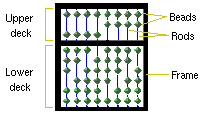
FIGURE: The Anatomy of a Chinese Abacus.
This figure identifies the various parts of a Chinese abacus.
Calculations are performed by placing the abacus flat on a table or one's lap and manipulating the beads with the fingers of one hand.
Each bead in the upper deck has a value of five; each bead in the lower deck has a value of one.
Beads are considered counted, when moved towards the beam that separates the two decks.
The right-most column is the ones column; the next adjacent to the left is the tens column; the next adjacent to the left is the hundreds column, and so on. After 5 beads are counted in the lower deck, the result is "carried" to the upper deck; after both beads in the upper deck are counted, the result (10) is then carried to the left-most adjacent column. Floating point calculations are performed by designating a space between 2 columns as the decimal-point and all the rows to the right of that space represent fractional portions while all the rows to the left represent whole number digits.